


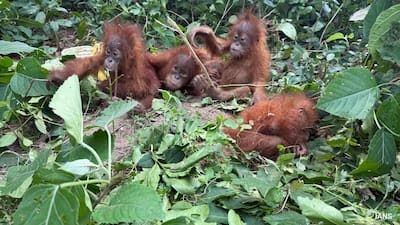
Their unexpected presence attracted attention because orangutans are not native to India and have never been naturally found in the country
Five baby orangutans have been rescued from a forest in Odisha, thousands of kilometres from the only places where the animals naturally live, prompting authorities to investigate how the young apes reached India.The Odisha discovery is unusual because orangutans are non-native to India and are naturally restricted to a small part of Southeast Asia. According to BBC, the five juveniles were found in a casuarina plantation in the Udayapur-Talsari area of Balasore district. Wildlife officials suspect the animals may have been brought into India illegally, although the exact circumstances remain under investigation.
The rescued orangutans have since been shifted to Nandankanan Zoological Park in Bhubaneswar, where they are being kept in quarantine and undergoing veterinary checks, PTI reported. Odisha Forest and Environment Minister Ganesh Ram Singh khuntia said each orangutan could fetch around Rs 20 lakh to Rs 25 lakh in international markets, raising concerns that the animals may have been part of an illegal wildlife- trafficking operation. Officials are examining how the animals could have been transported into the state, including possible movement through air, water or rail routes
What exactly are orangutans?
Although they are sometimes casually described as monkeys, orangutans are great apes, belonging to the same broader ape family as gorillas, chimpanzees, bonobos, and humans. They are not monkeys because, among other anatomical differences, great apes do not have tails.Orangutans belong to the genus Pongo and are the only great apes naturally found in Asia. Their name comes from the Indonesian and Malay words meaning “person of the forest”, as per World Wildlife.
They are immediately recognisable by their long,shaggy orange or reddish-brown hair, extremely long arms and grasping hands and feet. Their bodies are exceptionally adapted to life in trees. Orangutans are considered the world’s largest arboreal, or tree- dwelling, mammals and spend much of their lives moving through forest canopies
Their arms are significantly longer than their legs,allowing them to climb, clamber and swing between branches. Unlike many other primates, orangutans generally live relatively solitary lives, with mothers and their young forming the most important long- term social relationship, according to Smithsonian’sNational Zoo and Conservation Biology Institute.
Where do orangutans naturally live?
Wild orangutans are found only on the Southeast Asian islands of Borneo and Sumatra. Borneo is divided among Indonesia, Malaysia and Brunei, although wild orangutans are found in the Read In App Indonesian and Malaysian parts of the island. Sumatran orangutans are found on Indonesia’s Sumatra. The recently recognised Tapanuli orangutan has an even smaller range in the Batang Toru ecosystem of North Sumatra, as per National Geographic.This makes the Odisha discovery particularly unusual. Researchers found the five animals in an environment thousands of kilometres from the tropical forests where their species evolved.
Scientists recognise three living orangutan species:Bornean orangutan (Pongo pygmaeus),Sumatran orangutan (Pongo abelii),Tapanuli orangutan (Pongo tapanuliensis).Bornean and Sumatran orangutans can look similar, although Sumatran orangutans generally have longer hair and some differences in facial and body features. Tapanuli orangutans are considered a distinct species and have an extremely restricted range in Sumatra. Authorities have not yet publicly established which species the five rescued juveniles belong to.
What do orangutans eat?
Fruit forms a major part of an orangutan’s diet, although they are not exclusively fruit-eaters. They also consume leaves, flowers, bark, insects and other vegetation. When food is scarce, they may eat bird eggs and occasionally small animals. They can also obtain water from fruits, leaves and tree holes.The young orangutans found in Odisha were photographed eating bananas after their rescue, although bananas would not necessarily represent their natural diet in the wild.
Why are orangutans critically endangered?
The animals face severe pressure in their native habitats. Deforestation, logging, agricultural expansion, fires, hunting and illegal wildlife trafficking have all contributed to their decline. The expansion of palm-oil plantations is another major driver of habitat loss in parts of their range.Infant orangutans are particularly vulnerable to the illegal pet trade. Because young animals are easier to capture and transport, poacher may target mothers with infants, often killing the mother in the process. Their slow reproductive rate makes the situation even more serious. Orangutan mothers invest years in raising their young, with infants remaining dependent on them for a long period. Consequently, populations
